Cellular supply and demand
Who gets the NAD+ budget? Shop Vital Peptides
A shop name suggests taking stock. The outgoing account interests me more: which cellular jobs are drawing on NAD+?
NAD+ demand in an inflamed cell
An inflamed immune cell has expenses. In experiments on mouse macrophages, inflammatory activation caused reactive oxygen species to damage DNA. That activated PARP, an enzyme that consumed NAD+, and left the cells dependent on NAD+ recycling to sustain their altered metabolism.
I had pictured replenishment as an uncomplicated favour to a tired cell. This experiment gives replenishment a busier meaning: the supply helps an already inflamed cell carry on with its work. My inference concerns the activity being supplied, which makes the word vital more interesting. Vital to which activity?
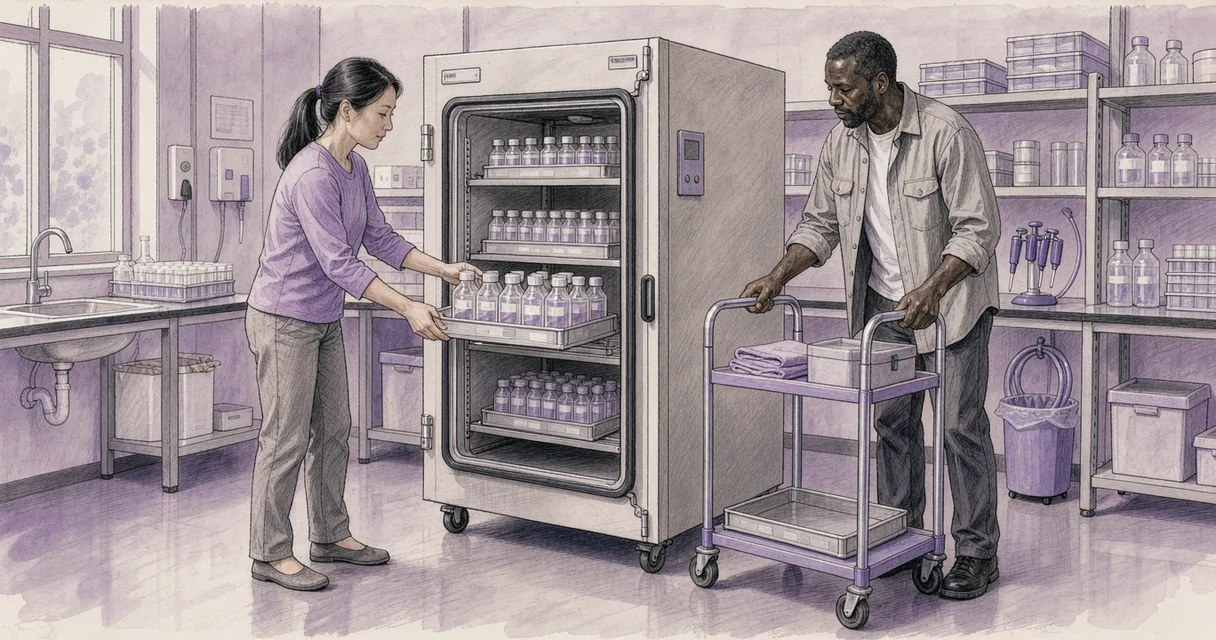
The opening picture imagines technicians tending cell cultures. It represents laboratory work; it does not depict the experiment or its authors.
Depletion and inflammation
There is an awkward companion result. In another mouse-macrophage experiment, depleting NAD+ helped prime an inflammatory response; restoring NAD+ with NMN reversed that effect. A shortage can cause trouble, while replenishment can also support a cell that is already activated.
I wouldn’t flatten those experiments into a verdict for more or less NAD+. They concern different cellular conditions. Their tension is the reason for a closer account of inflammation.
Muscle and precursor essays
The human work asks a different set of questions. One NMN trial in prediabetic, postmenopausal women improved muscle insulin sensitivity without changing body composition or HbA1c. Another trial in healthy middle-aged adults reported improved walking distance. Those findings deserve their own room, away from the mouse immune cells.
Muscle outcomes considers the observations and the trial results together. Precursor processing takes a different journey: the material supplied can be transformed before it reaches its destination. The reading list gathers the studies behind these essays.